Care and specialist advice
Use a stone-compatible routine for day-to-day cleaning. New or enlarging holes, loose filler and damaged edges need assessment before filling. A restoration specialist can advise how repair and refinishing would suit the surrounding travertine.
Travertine has a naturally open structure
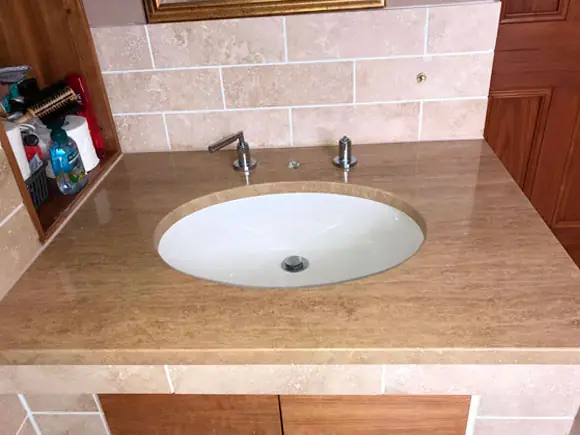
Travertine contains voids formed within the stone. Some are exposed at the surface and may be filled during fabrication; others remain below it. The Natural Stone Institute explains that a thin layer over a shallow void can break, exposing a previously hidden opening. It also notes that aggressive maintenance can remove existing filler.
That explains why a new hole does not, on its own, prove poor-quality stone. It also does not diagnose your floor. The location, pattern and condition around each opening still need to be considered.
Further reading: Natural Stone Institute: travertine voids.
Record where the change is happening
Take an overall view of the room and close-ups of a few representative openings. Note whether they are concentrated in a walkway, beneath furniture or near a doorway. Say when you first noticed them and whether more have appeared since then.
Include the cleaning products, brushes or machinery used, if known, and any previous filling work. Describe the surrounding joints separately. A hole within a tile and a gap between tiles are different observations, even when they occur close together. If you do not know the material name, include the supplier's description rather than testing the floor yourself.
Ask how filling would fit the existing finish
Discuss whether filling is appropriate for the area and how its colour and surface finish would be selected. Ask whether the work is limited to individual openings or whether the surrounding finish also needs attention. Show an area of the floor whose appearance you would like to retain.
A filled surface and an intentionally unfilled surface can look different. The quotation should make the intended result clear, including the possibility of visible repairs. Use the repair service guide to begin that discussion, and read how refinishing differs from sealing if both appear in the proposal.
Review maintenance as well as the repair
Keep the agreed aftercare instructions with the repair record. Ask which routine is suitable for the material, the filler and the finish, and when the area can return to normal use. Avoid introducing a different product simply because it is labelled for tiles.
Our everyday stone care guide explains the information worth keeping. You can also explore stone cleaning photographs before discussing your own floor. Those photographs show the business's existing work; they do not identify the cause of holes in another installation.
Send your approximate floor area, postcode and photographs through the restoration enquiry. Mention whether filling, cleaning, finish restoration or a combination is the question you want assessed.
This guide explains general considerations. The appropriate treatment and expected result need assessment of the actual surface.