Care and specialist advice
Routine care can be straightforward: remove loose grit, clean with a product suitable for your stone and follow its instructions. If marks remain, the finish changes or you are unsure of the material, ask a stone restoration specialist before using stronger products or abrasive treatments.
How should you clean natural stone?
Remove loose grit gently and use a cleaner suitable for the specific stone. For routine care, a compatible pH-neutral cleaner is a useful starting point. Follow its instructions and avoid mixing cleaning chemicals.
Clean up spills promptly rather than leaving them on the surface. Acidic products can damage acid-sensitive materials, so a general bathroom or limescale cleaner should not be assumed suitable for natural stone.
Further reading: Natural Stone Institute: care and cleaning.
What is worth recording about your surface?
- The stone name, supplier and existing finish, if known.
- Any sealant, coating or treatment previously applied.
- The cleaner recommended for the surface and its dilution instructions.
- Any project-specific advice about drying, curing or returning the area to use.
If that information is missing, ask before changing products. “Natural stone” covers materials with different characteristics; one routine does not automatically suit every installation.
Further reading: Stone Federation: choosing and caring for natural stone.
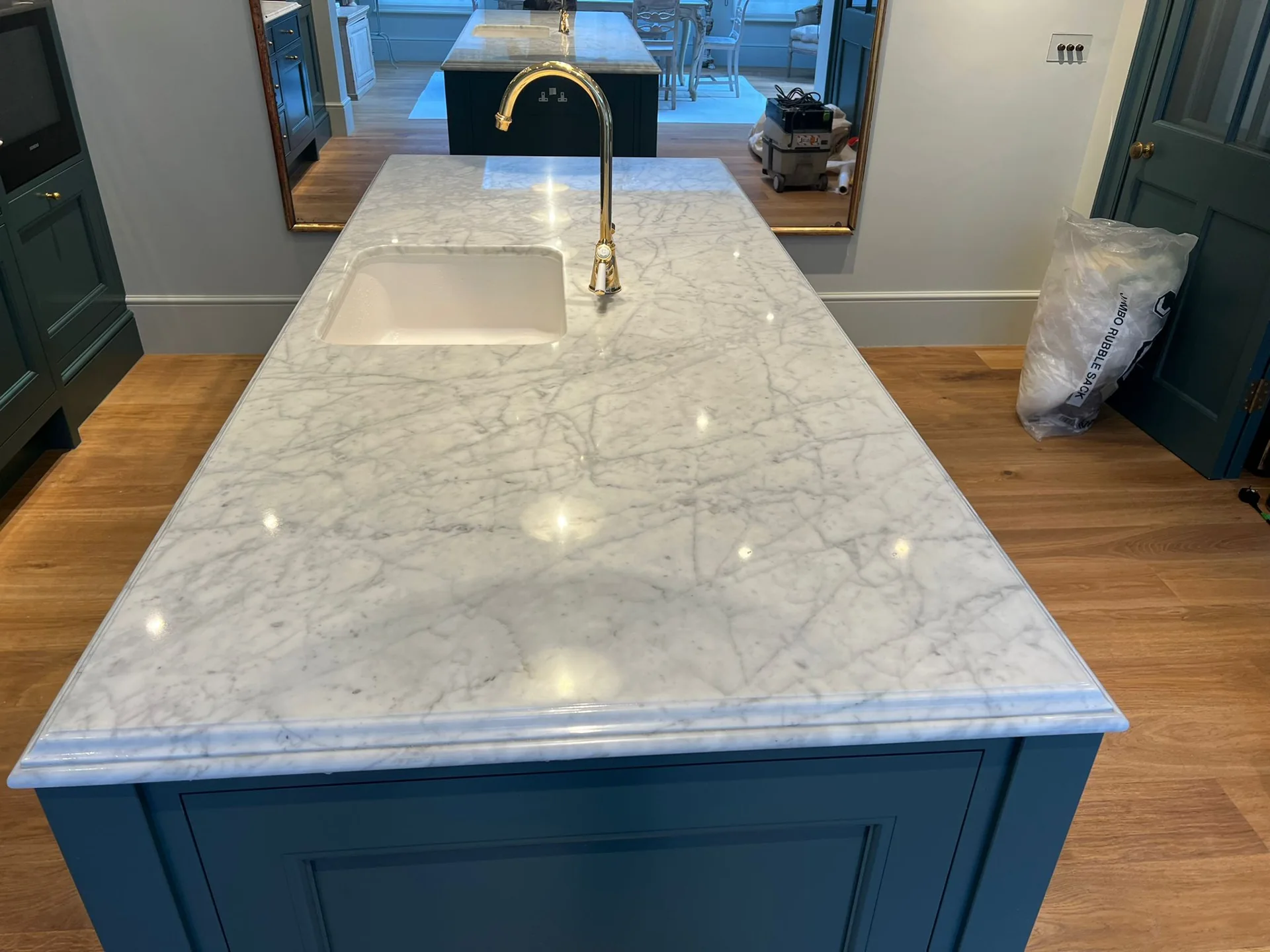
How do you clean a marble worktop?
For routine marble worktop care, use a compatible cleaner as directed and blot spills promptly. Acidic food and drink, including wine, citrus and vinegar, can etch marble. A changed finish is different from a deposit that can be washed away.
Wipe spills as they happen rather than at the end of cooking, and dry the surface afterwards instead of leaving it wet. Use a board for food preparation and coasters under glasses and bottles. Keep limescale sprays and cream cleaners away from the worktop entirely, however effective they are elsewhere in the kitchen.
Hard-water deposits around a sink can be difficult to distinguish from finish damage. If normal compatible cleaning does not resolve the mark, ask a specialist to assess it before trying a descaler or abrasive product.
Further reading: Natural Stone Institute: care and cleaning.
How do you clean a marble floor?
Grit brought in on shoes can scratch a marble floor. Remove it gently with a clean dust mop or a suitable vacuum attachment, and use entrance mats to reduce the amount carried indoors.
- Sweep or vacuum before washing, every time.
- Use barrier matting at external doors.
- Use a soft mop and change the water when it turns dirty.
- Dry the floor rather than leaving it to air-dry.
- Put felt pads under anything that gets dragged.
An uneven sheen may come from residue, surface wear or an earlier treatment. If a compatible cleaning routine does not improve it, a specialist can assess whether the floor needs professional cleaning or refinishing.
Which products should you keep away from stone?
Most avoidable damage comes from products sold for other surfaces. Limescale and bathroom descalers, cream cleaners sold for ceramic, vinegar, lemon juice and general acidic sprays can all affect acid-sensitive stone such as marble, limestone and travertine. Bleach and strongly alkaline degreasers are a separate concern, and can affect a finish or a previously applied treatment even on stone that is not acid-sensitive.
Abrasive pads and powders are the other common cause. They may remove a mark, but they do so by altering the finish, which leaves a patch that reflects light differently from the surface around it. That patch is then a refinishing question rather than a cleaning one.
If a product is not described as suitable for your specific stone, the safer course is to ask before using it. Where a mark has already appeared, our etching and staining guide explains how to describe it.
Further reading: Natural Stone Institute: care and cleaning.
When does cleaning stop being enough?
Record where the change appears, when you first noticed it and whether the area is used differently from the rest of the surface. Take an overall photograph and a close-up. Avoid repeated product trials that make the treatment history harder to explain.
Our etching and staining guide helps describe a changed appearance. See stone-cleaning project photographs and the cleaning service guide to explore the next conversation.
This guide explains general considerations. The appropriate treatment and expected result need assessment of the actual surface.